Tuesday, April 26, 2011

Taiwan arms purchases help US economy - Wendell Minnick

MH-60L Direct Action Penetrator (DAP)Image via Wikipedia
Ending US weapon sales to Taiwan might also end a very lucrative trade that has helped the US economy greatly, writes Wendell Minnick in Defense News. Taiwan has spent USD 16,5 billion over the past five years, but calls to end the trade become louder.
In January, a roundtable discussion at the University of Virginia’s Miller Center of Public Affairs recommended the U.S. “re-examine” continued arms sales to Taiwan in an effort to improve ties with China. Members of the roundtable included Joseph Prueher and Timothy Keating, both retired U.S. Pacific Command commanders, and James Shinn, a national intelligence officer for East Asia at the Central Intelligence Agency. The roundtable report said arms sales to Taiwan had damaged Sino-U.S. ties and had become a “vicious circle.” The report further recommended that Washington re-evaluate the Taiwan Relations Act.
But a report has now detailed the economic benefits:
The CRS report, “Taiwan: Major U.S. Arms Sales Since 1990,” by Shirley Kan, indicates that Taiwan arms sales generate big revenue for U.S. defense companies despite the absence of a defense treaty with Taiwan. In 2007, Taiwan bought $3.7 billion in U.S. arms; in 2008, $6.4 billion; and in 2010, $6.4 billion. No sales to Taiwan were approved in 2009. Among customers of U.S. arms worldwide, Taiwan ranked fourth behind Egypt, Israel and Saudi Arabia from 2002 to 2009.


From 2000 to 2010, under the U.S. Foreign Military Sales program, Taiwan procured Patriot Advanced Capability-3 missile defense systems, UH-60M Black Hawk helicopters, Harpoon missiles, Osprey-class mine-hunting ships, Kidd-class destroyers, AIM-120 ad­vanced medium-range air-to-air missiles, Standard Missile-2 Block IIIA air defense missiles, a surveillance radar program for early warning of Chinese missile launches, AH-64D Apache Longbow attack helicopters and P-3C Orion anti-submarine patrol aircraft.


Wendell_MinnickImage by Fantake via Flickr
Wendell Minnick
More in Wendell Minnick's article.

Wendell Minnick is a speaker at the China Speakers Bureau. When you need him at your meeting or conference, do get in touch.
Enhanced by Zemanta

Labels: , , ,

Tuesday, March 8, 2011

Taiwan spy case focuses on disrupting communications - Wendell Minnick

Wendell_MinnickrevWendell Minnick
The high-profile Taiwanese spy general Lo keeps on rocking the military establishment. In the Wall Street Journal Wendell Minnick gives his take on the largest spy case in 50 years in Taiwan.
The Wall Street Journal:
Wendell Minnick, the Asia bureau chief of Defense News, an independent defense trade periodical, said he believed that Gen. Lo could have caused damage in other ways because he had access to sensitive international military cables while working as an attaché. He may also have worked as a "talent spotter" recruiting other officers to spy for China, Mr. Minnick said.
China has long sought details of the Po Sheng program. The technology featured prominently in a 2008 case in which an employee at a U.S. Department of Defense agency, Gregg Bergersen, gave out secret information about the program to a naturalized U.S. citizen from Taiwan named Kuo Tai-shen with the understanding the leaks would lead to business opportunities for Mr. Bergersen. But Mr. Kuo sent the information to a Chinese official in Guangzhou, according to an affidavit relating to the case. He was sentenced to more than 15 years in prison while Mr. Bergersen received a 57-month sentence and three years supervised release.
The Chinese focus on the Po Sheng program shows its intense interest and progress in developing the capability to disrupt Taiwanese communications ahead of an attack, according to Mr. Minnick. He added the arrest itself was also an impressive achievement for Taiwan's counterintelligence.
Wendell Minnick is a speaker at the China Speakers Bureau. When you need him at your meeting or conference, do get in touch.
Enhanced by Zemanta

Labels: , , ,

Friday, February 25, 2011

Taiwan still looking into espionage damage - Wendell Minnick

Ministry of National Defense (Republic of China)Ministry of Defense, Taipei via Wikipedia
Taiwan is still trying to assess the amount of damage caused by one of the largest espionage case, after the late-January arrest of General Lo Hsien-che, who ran the communications, electronics and information division of Army Command Headquarters, writes Wendell Minnick in Defense News.

The one-star general stands accused of compromising the Po Sheng (Broad Victory) C4I program. Po Sheng includes a fiber-optic communication cable network and procedures for sharing information with U.S. Pacific Command.
In Defense News:
Ministry of National Defense (MND)... officials announced his arrest Feb. 8, and said a damage assessment team is looking into how much Lo may have given China.
U.S. officials are pressuring Taiwan to be more transparent about the damage allegedly caused by Lo. The consequences could include losing the Pentagon's confidence in Taiwan's ability to protect U.S. defense technologies sold to the self-rule island. Taiwan is pushing Washington hard for the release of new F-16 fighter aircraft and is awaiting delivery of Patriot PAC-3 air defense missile systems and P-3C Orion maritime patrol aircraft. All are technologies China is anxious to learn more about.
One former Taiwan defense attaché said the MND is unlikely to dig too deeply. There's a long tradition of "making a big issue small" (da shi hua xiao) in Taiwan's military bureaucracy, the former attaché said.
"Even if the top leader asks whoever is in charge of the investigation to be completely honest, from the second level down, people will most likely try to make it sound less serious," he said.
More in Defense News.
Wendell_MinnickrevImage by Fantake via Flickr
Wendell Minnick

Wendell Minnick is currently preparing a book on Chinese espionage that is due coming summer. He is also a speaker at the China Speakers Bureau. Do you need him at your meeting or conference? Do get in touch.

Enhanced by Zemanta

Labels: , , , ,

Friday, January 21, 2011

Taiwan's missiles "no message for China or US" - Wendell Minnick

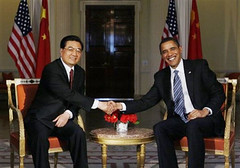
Presidents Obama and Hu JintaoNo message for them by rebuildingdemocracy
Taiwan test-fired eleven types of missiles last Tuesday, but denies any link with China's Hu Jintao's state visit to the US, writes Wendell Minnick in Defense News.
Taiwan test-fired missiles of 11 different types during an exercise on Jan. 18 at the Jiupeng Missile Test Range in Pingtung County on Taiwan's southeast coast. The tests coincided with Hu's visit to Washington to meet with U.S. President Barack Obama.
A Taiwan military official denied the tests were an attempt to send a political message to Beijing or Washington. He said the tests were scheduled long before the announcement of Hu's visit.
There was a political message, Minnick write, but only for domestic use, after the J-20 fighter test flight in China. Unfortunately, that message misfired, as many of the missiles did not hit target:
Taiwan President Ma Ying-jeou expressed disappointment and called for the military to better prepare itself in the future. A Taiwan military official expressed concern over Ma's remarks and described the test as a complex exercise involving different elements of the Air Force, Army and Marine Corps from around the island.
The tests were a rare event that included virtually every air-to-air and surface-to-air missile in Taiwan's arsenal minus the AIM-120 AMRAAM and Patriot PAC-2 missile systems, said another military official. The last public missile test at Jiupeng was in 2002 and was of a much smaller scale, he said.
More in Defense News.
Wendell_MinnickWendell Minnickby Fantake via Flickr


Wendell Minnick is a speaker at the China Speakers Bureau. When you need him at your meeting or conference, do get in touch.
Enhanced by Zemanta

Labels: , , , ,

Thursday, November 18, 2010

Taiwan buys a useless helicopter - Wendell Minnick

An AH-64D Apache LongbowThe wrong helicopter via Wikipedia
Taiwan's decision to purchase 31 AH-64D Apache Longbow attack helicopters for US$ 2.5 bn in stead of Cobras is blasted in an article in Atimes, as it does not fit any of the island's defense strategies. Defense expert Wendell Minnick explains why the decision is odd, to say the least.
"Taiwan has a high mountainous interior with low salty coastlands. Neither are friendly to Apaches," said Wendell Minnick, Asia bureau chief for Defense News, in an interview with Asia Times Online. "Taiwan wanted Apaches largely because they are the latest, most technologically advanced piece of equipment in the US arsenal, but it's the Cobras, which are popular with the US Marine Corps, that can handle the types of environments found in Taiwan with ease." 
The AH-1W Super Cobras Minnick recommends are the backbone of the US Marine Corps' attack helicopter fleet. Over the next decade, they will be replaced by the AH-1Z Viper upgrade, which is widely called "Zulu Cobra" in reference to its variant letter. The marines placed orders for more than 400 AH-1Zs, and one of the things that makes the Zulu Cobra especially suitable for a military that fights in proximity of seashores is that its rotor blades come with a semi-automatic folding design, which allows the helicopter to be stored aboard amphibious assault ships. The Longbow radar that gives the AH-64D Apache Longbow its name can also be mounted, along with the same missiles and rockets as the Apache. 
Neither from a military nor an economic point of view does Minnick see why Taiwan would choose the Apaches over the Cobras. "Taiwan already has two squadrons of AH-1W Super Cobra attack helicopters. It was given an option to procure 30 new Zulu Cobras and was offered an upgrade of their older Super Cobras up to Zulu standards. That would have given them 90 AH-1Z heavy attack helicopters in their inventory. But instead they chose Apaches."
Commercial
Wendell_MinnickrevWendell Minnick


Wendell Minnick is a speaker at the China Speakers Bureau. When you need him at your conference or meeting, do get in touch.

Labels: , , , , ,

Thursday, November 4, 2010

Taiwan's military intelligence thorough infiltrated - Wendell Minnick

Wendell_MinnickrevWendell Minnickvia Flickr
Two high-profile arrests in Taiwan show that China has thoroughly infiltrated Taiwan's Military Intelligence Bureau (MIB), writes Wendell Minnick in Defense News.
Col. Lo Chi-cheng of the MIB and Taiwanese businessman Lo Pin are accused of supplying Beijing with the identities of MIB agents working in China. Both men were arrested Nov. 1. The number of MIB spies compromised since the two began giving information to China in 2007 was not revealed.
The MIB is responsible for collecting military intelligence within China and has a history of recruiting Taiwanese businessmen working in China.
The MIB recruited Lo Pin in 2005 to collect intelligence in China, but after a year, Chinese authorities arrested and allegedly tortured him. Lo Pin agreed to return to Taiwan as a double agent and recruited his MIB handler, Lo Chi-cheng, paying him about $100,000 over four years.
In Defense News an overview of earlier cases of infiltration into the MIB.

Commercial
Wendell Minnick is a speaker at the China Speakers Bureau. When you need him at your meeting or conference, do get intouch.

Labels: , , , , ,

Monday, November 1, 2010

Despite funding problems, Taiwan Marines want their vehicles - Wendell Minnick


U.S. Marines disembark Amphibious Assault Vehi...
Image via Wikipedia
Although Taiwan's military have problems in making ends meet, and have even deferred advanced US weapon systems, the island's Marines want to push ahead with the purchase of new vehicles, writes Wendell Minnick in Defense News. 
Taiwan’s Marine Corps is pushing for more money to replace its remaining LVTP-5A1 amphibious assault vehicles.


In 2006, the service replaced the first half of its LVTPs with 54 re built AAV-7A1 amphibious assault vehicles.


Four years later, the Marines are still waiting for the Navy to release funds for 65 more AAV-7s, said a local defense industry source.


A Taiwan defense official confirmed the budget has been delayed, but denied the Navy was doing it intentionally. The entire national defense budget is taking hits to pay for $13 billion worth of new arms and equipment ordered over the last three years, including P-3C Orion maritime patrol aircraft, Patriot PAC-3 air defense missile systems, AH-64D Apache attack helicopters and UH-60 Black Hawk utility helicopters.


More at Wendell Minnick's weblog.

Wendell_MinnickrevWendell Minnick via Flickr

Commercial

Wendell Minnick is a speaker at the China Speakers Bureau. When you need him at your conference or other meeting, do get in touch.

Labels: , , , , ,

Thursday, October 28, 2010

Taiwan returns rockets and hurts US ties - Wendell Minnick

Wendell_Minnickrev Wendell Minnck via Flickr
The surprise move by Taiwan to defer two advanced weapon systems from the US is going to hurt its ties with its American allies, says Wendell Minnick in a comment for Reuters.
"It's going to hurt (Taiwan) in Washington to fight for these systems and then say they can't afford them," said Wendell Minnick, Asia bureau chief with Defense News. "It would discourage people in Washington who push hard for the releases."
Taiwan's military are facing a shortfall in funding, Wendell Minnick wrote earlier this month for Defense News.

Commercial
Wendell Minnick is a speaker for the China Speakers Bureau. When you need him at your meeting or conference, do get in touch.

Labels: , , , ,

Friday, October 22, 2010

Taiwan rocket story ´political´ - Wendell Minnick

Sun Yat-Sen Memorial Hall in Taipei, Republik ...Taiwan via Wikipedia
Director General Tsai De-sheng of the Taiwanese National Security Bureau said this week that the number of rockets  pointing at the island from China have risen to 1,400, but defense specialist Wendell Minnick is not convinced by the story, he tells Japanese media.
Wendell Minnick, Asia bureau chief for industry newspaper Defense News, expressed skepticism at the announcement and the lack of detail on the missiles that make up the total.
Adding to the confusion, Tsai said the figure included not only ballistic missiles but also long-range cruise missiles that would not likely be used against Taiwan, instead acting as "anti-access weapons" against countries intervening in a cross-strait conflict.
"This might be a political move, an attempt to encourage the Americans to release weapons to Taiwan," Minnick said, referring in part to 66 F-16 C/D fighters long sought by Taipei but whose sale is strongly opposed by Beijing.
Commercial
Wendell Minnick is a speaker at the China Speakers Bureau. When you need him at your meeting or conference, do get in touch.
Wendell_MinnickrevWendell Minnick via Flickr

Labels: , , , , ,

Monday, October 4, 2010

Taiwan's military running out of funding - Wendell Minnick

Wendell_MinnickrevWendell Minnick via Flickr
Taiwan's military are running out of money because of huge outstanding bills for the US and a reduced defense budget, writes Wendell Minnick in Defense News. New procurements might not be possible in the upcoming three years.
Wendell Minnick in his weblog:
Taiwan is facing more than $13 billion in bills for arms released by the U.S. government since 2007.


The overall defense budget has dropped since 2008 — from $10.5 billion to a proposed $9.2 billion for 2011, submitted to the legislature Aug. 30. The new budget represents 16.6 percent of the national budget and 2.7 percent of the gross domestic product.


The government is also, due to increasing economic hardship, borrowing money to finance the 2011 national budget — something that is relatively unheard of in Taiwan, sources said.


Still, procurement plans are still in place for the next ten years.
The list includes 66 F-16C/D fighter aircraft, six C-27J cargo aircraft, upgrades for 145 aging F-16A/B fighters, upgrades to two Dutch-built diesel submarines and six French-built La Fayette frigates, two more U.S.-built Newport-class tank landing ships and eight new diesel submarines — a longstanding request.


Taiwan’s Air Force has also been considering buying T-50 Golden Eagle attack jet trainers from Korea Aerospace Industries, Seoul, to replace aging AT-3 Tzu Chiang attack trainers and F-5 fighters used for training.


More analysis in Wendell Minnick's weblog.

Commercial
Wendell Minnick is a speaker at the China Speakers Bureau. When you need him at your meeting or conference, do get in touch.

Labels: , , , ,